
There are some online income ideas that I look at and immediately think:
Nope. Not for me.
Then there are others that make me stop and wonder…
Could I actually make that work?
Recently, I’ve been watching the growth of AI-generated image pages on Facebook. Some attract enormous audiences around everything from fantasy worlds and cute animals to nostalgia and imagined history.
And inevitably, the online-business part of my brain started asking questions.
Could you deliberately build one of these pages from scratch?
Could it attract an audience organically?
And, eventually, could that audience become an income stream?
I don’t know.
Which seemed like an excellent reason to try it.
So I’ve started a new experiment called The Layered Archives.
And rather than waiting until I know whether it succeeds before telling you about it, I’m documenting this one from the beginning.
Because sometimes the experiment is more useful than the eventual answer.
Can an AI image Facebook page make money?
An AI image Facebook page may be able to generate income if it builds an engaged audience and qualifies for suitable monetisation opportunities. I’m testing this by building The Layered Archives from scratch and documenting its growth, content strategy and results.
TL;DR
The Layered Archives is my new experiment in building an AI-image-focused Facebook page from scratch, with the long-term goal of seeing whether it can eventually generate income.
The first series I’m testing is called Recovered Moments. Each one starts with a real travel photograph — usually one of my own, although occasionally borrowed from Mum’s collection — and uses it as inspiration to explore what that same location may have looked like at another point in history.
I’m currently using Kre8or to create the Recovered Moments and Image Studio to resize and adapt them without unnecessarily using more Kre8or credits.
I’ve also secured the domain and matching social handles so the project has somewhere to grow if it gains momentum.
There is no income to report and no guarantee this experiment will work.
That’s precisely why I’m documenting it now.
This isn’t a guide to making money from an AI Facebook page.
It’s the beginning of an experiment to find out whether I can.
Why an AI Image Facebook Page?
I’ve become increasingly interested in using social media as more than somewhere to drop links to my websites and hope somebody clicks them.
Facebook in particular has made me curious.
Image-led pages can exist as their own little brands. People don’t necessarily need to leave Facebook for the page itself to have value.
That creates an interesting question from an online-income perspective.
What happens if you build the audience first?
Could the page eventually qualify for Facebook’s own monetisation options? Could it lead to other income opportunities? Could the images themselves eventually become products?
Maybe.
But we’re getting considerably ahead of ourselves.
Right now, I have a Facebook page, an idea and a growing collection of images.
That’s where this case study begins.
Meet The Layered Archives
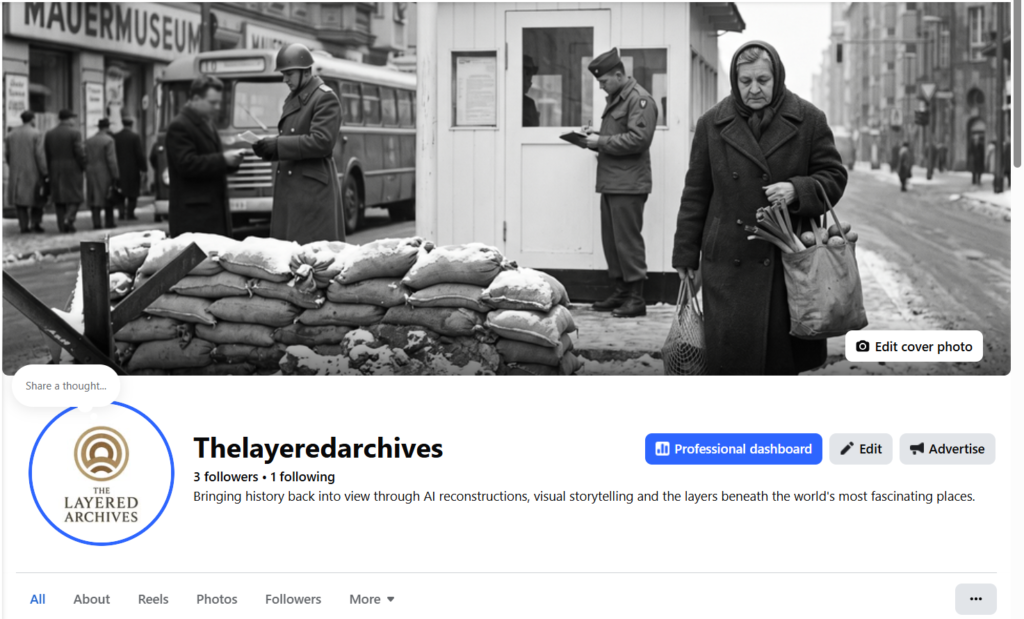
I didn’t want to create an AI image page simply because AI images happen to be getting attention.
If I was going to keep creating content consistently, the subject needed to be something I would still find interesting after the novelty disappeared.
That’s where The Layered Archives came from.
The concept combines several things I already enjoy: travel, culture, history, storytelling and experimenting with AI imagery.
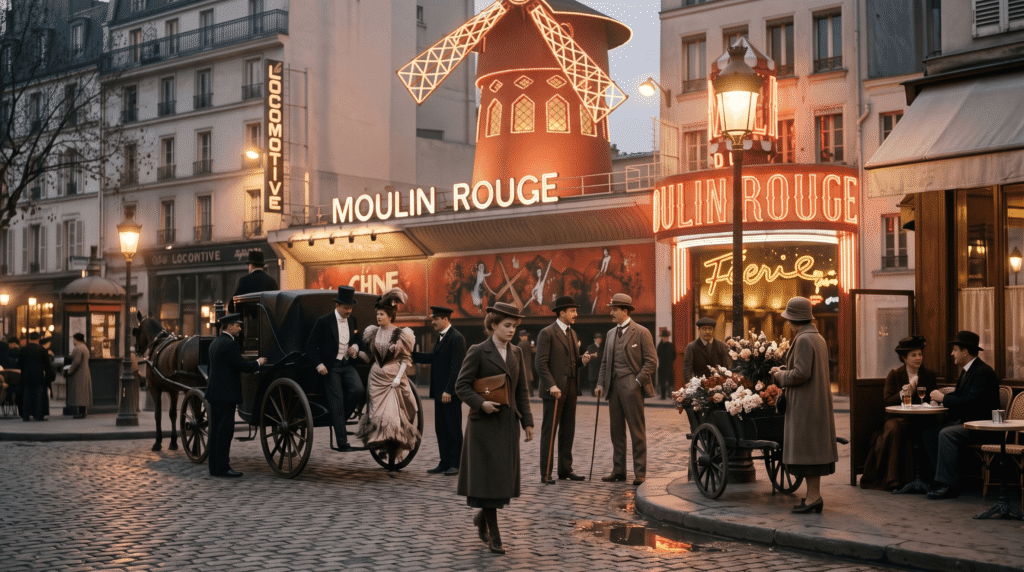
At the heart of the page is the first series I’m experimenting with: Recovered Moments.
And these don’t actually begin with AI.
They begin with a photograph.
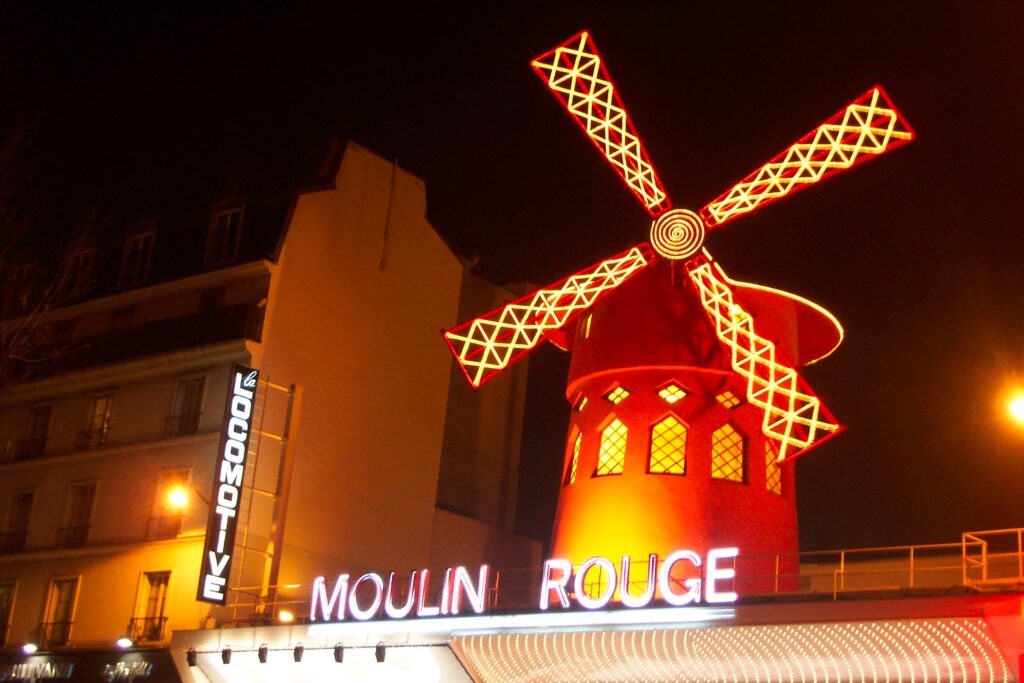
Usually it’s one I’ve taken during my own travels, although I’ve also been known to raid Mum’s travel photos when she has something useful.
I take that real photograph of a place as the starting point and then ask a different question:
What might this same place have looked like at another moment in its history?
That photograph becomes the inspiration for an AI-assisted Recovered Moment — taking us backwards through the layers of the location rather than simply generating a historical scene from scratch.
A place I’ve stood becomes a connection to another point in time.
Recovered Moments is only the first format I’m testing. I already have ideas for other series if the project gains momentum, but for now I’m deliberately starting with one concept and seeing how people respond.
Why I Think the Concept Matters
One of my concerns with starting an AI image page was ending up on the content treadmill.
Generate pretty image.
Post pretty image.
Generate another pretty image.
Repeat forever.
That’s not particularly appealing to me.
The Layered Archives gives each image a reason to exist.
There’s a story behind it.
There may be history to explore.
There may be a location connected to it.
There may be something unexpected in the ordinary details.
It also gives the page an identity beyond “look what AI made.”
Whether Facebook’s algorithm or its users care about that distinction remains to be seen.
But I care about it.
And if I’m going to create enough content to give this experiment a genuine chance, that’s probably quite important.
Building Somewhere for It to Grow
At this stage, Facebook is the experiment.
But I decided fairly early that if The Layered Archives did unexpectedly find an audience, I didn’t want to discover later that I’d built a recognisable name I couldn’t use anywhere else.
So I did a little future-proofing.
I purchased TheLayeredArchives.com and secured the matching social media handles on the other platforms I may eventually use.
That doesn’t mean I’m suddenly trying to build another enormous website and half a dozen social channels.
Definitely not. 😂
For now, the website is deliberately simple.
It has a Home page introducing the concept, an About page explaining what The Layered Archives is trying to do, and an Explore The Archives page that currently acts more like a marker for where the project could eventually go.
The Home page is also intended to bring the Facebook content onto the website through an embedded feed — although at the time of writing I’ve discovered that isn’t behaving quite as intended.
Another item for the never-ending website to-do list.
If the project doesn’t gain traction, I haven’t invested heavily in infrastructure it didn’t need.
But if it does?
The foundations are already there.
I can expand the website, introduce other types of historical visual storytelling, experiment with other social platforms and potentially explore completely different ways of monetising the audience.
For now, though, I’m resisting the temptation to build all of that before I have evidence anybody wants it.
Facebook first. Watch what happens. Then decide what deserves to come next.
The AI Part Is Deliberate Too
There’s another important distinction I want to make from the beginning.
The original photograph is real.
The Recovered Moment is an AI-assisted interpretation.
I’m not trying to pass the finished images off as genuine historical photographs. The entire concept depends on taking a real place we can see today and imagining one of the historical layers beneath it.
That makes AI particularly interesting for this project.
I can start with somewhere I’ve actually visited and use visual storytelling to explore a version of that same place I could never have photographed myself.
But it also comes with a responsibility to be clear about what people are seeing.
These are interpretations inspired by history, archaeology, architecture and cultural context — not documentary evidence of exactly how a place looked.
The aim is to create curiosity about history, not confusion about what is historically authentic.
How I’m Creating the Recovered Moments
This experiment has also given me another real-world use for Kre8or.
I’ve already written about where Kre8or is beginning to fit into my website workflow, but The Layered Archives pushes it in a slightly different direction.
Instead of creating an image because I need a graphic for an existing article or social post, the image itself becomes the content.
I’m using Kre8or to create the original Recovered Moments and establish the visual idea.
But I’m also trying to be sensible about my credits.
Once I have an image I’m happy with, I don’t necessarily need Kre8or to recreate it simply because Facebook, Pinterest or another platform needs different dimensions.
That’s where Wealthy Affiliate’s Image Studio comes back into the workflow.
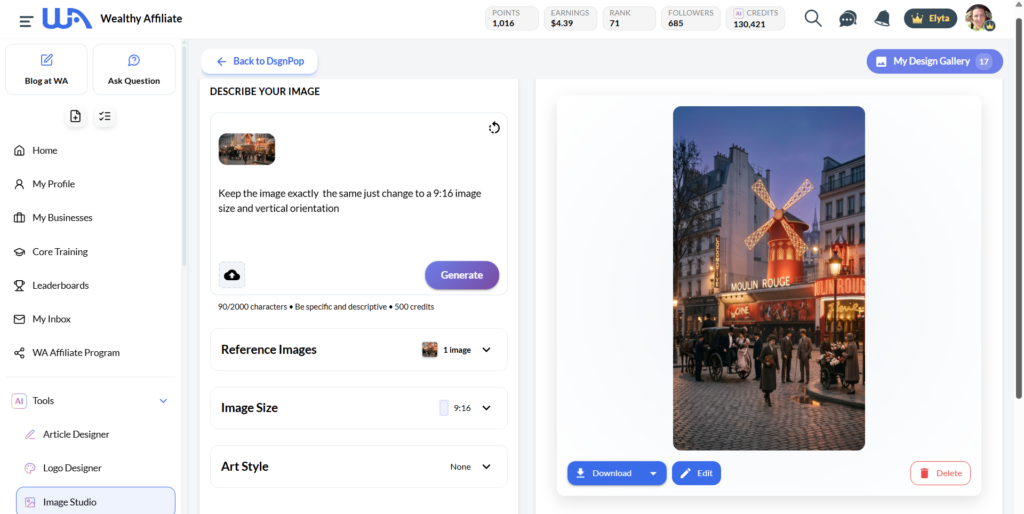
I can take the finished image and resize or adapt it there, preserving my Kre8or credits for the part of the process where I actually need them:
Creating something new.
It is a small optimisation.
But small optimisations matter when you’re trying to build something without spending money unnecessarily.
And if you’d like to experiment with Kre8or yourself, you can start with my invite below.
Disclosure: I may earn a commission if you join through my link, at no additional cost to you.
Why I’m Not Upgrading Kre8or Yet
At the moment, I’m deliberately working with the Kre8or credits I already received when a Beta Tester, than immediately purchasing a membership.
There are two reasons.
The first is simply that I don’t need to yet.
One of the easiest ways to turn an online-income experiment into an expensive hobby is to start buying every tool you might need before you’ve established whether you actually need it.
I’d rather encounter the limitation first.
The second reason is Black Friday.
Kre8or comes from the founders of Wealthy Affiliate, and Wealthy Affiliate has historically offered significant Black Friday deals.
That doesn’t mean Kre8or will.
I have no inside knowledge of a future Kre8or sale, and there may not be one at all.
But we’re close enough to Black Friday that I’m personally happy to wait and see.
In the meantime, stretching my existing credits has become part of the experiment.
Though if I find myself in need of credits before Black Friday, I will be upgrading.
Could The Layered Archives Actually Make Money?
And here we reach the big question.
Maybe.
That’s about as confidently as I’m prepared to answer it today.
There are several possible directions the project could eventually take.
Facebook itself may provide monetisation opportunities if the page grows enough to meet whatever eligibility requirements apply at the time.
There could eventually be opportunities involving the images themselves.
I’ve already had thoughts about prints and other products.
And because the subject naturally overlaps with travel and history, there may be completely different opportunities that I haven’t thought of yet.
But I don’t want to build the project backwards.
Monetisation isn’t Stage One.
Building something people actually want to follow is Stage One.
Without an audience, all those clever monetisation ideas are fairly meaningless.
So that’s what I’m concentrating on first.
What I’m Actually Measuring
I don’t want follower count to become the only definition of success.
I’ll obviously be watching it.
But I’m also interested in what Facebook does with the content.
Which images receive reach beyond existing followers?
Which subjects attract reactions?
Do people comment?
Do they share?
Does one type of Recovered Moment consistently outperform another?
Does video eventually outperform the static images?
And perhaps most importantly:
Can I maintain the project consistently without it becoming another job?
That last question matters.
An income stream isn’t particularly gentle if maintaining it requires feeding a content monster seven days a week.
This Is Not a “How to Make Money With AI Images” Guide
I think this deserves saying explicitly.
I haven’t made money from The Layered Archives.
At the time I’m writing this, the project is in its infancy.
I don’t know whether it will grow quickly, slowly or barely at all.
I certainly don’t know whether it will ever produce meaningful income.
There are plenty of articles online that will happily tell you how to make money doing something their author may never have actually done.
I don’t want this to become one of them.
Instead, I’m putting the starting point on record.
Then we can come back.
What happened after 30 posts?
After 100?
Did Reels change anything?
Did Facebook start distributing the images?
Did followers appear?
Did any monetisation opportunities emerge?
Did I completely change the strategy?
Or did the whole experiment quietly disappear into the giant internet graveyard of ideas that sounded good at the time?
All of those are useful outcomes to document.
The Experiment Starts Here
The Layered Archives currently has something much simpler than a business plan.
It has a hypothesis:
Can I build an audience around AI-created historical imagery and eventually turn that audience into an income stream?
Now I get to test it.
I’ll create the Recovered Moments.
I’ll experiment with static images and video.
I’ll watch what gets distributed and what disappears without a trace.
I’ll adjust as I learn.
And if monetisation eventually enters the picture, I’ll document that too.
For now, though, there isn’t an exciting income screenshot to show you.
There isn’t a viral-growth graph.
There isn’t a magic formula.
There’s simply a new Facebook page starting at essentially zero.
Which, when you’re running a case study, is actually a pretty good place to begin.
FAQ
What is The Layered Archives?
The Layered Archives is an AI-assisted visual storytelling project I’m building around history, culture and the layers hidden beneath places we can visit today. Its first series, Recovered Moments, begins with a real travel photograph and uses AI to imagine that same location at another point in its history.
How do I create the Recovered Moments?
Each Recovered Moment starts with a real photograph, usually from my own travels or occasionally from my mum’s collection. I use the photograph as the visual starting point for an AI-assisted interpretation of the same location during another historical period.
Can you make money from an AI image Facebook page?
Potentially, but this case study isn’t proof that you can. I’m starting The Layered Archives from scratch specifically to explore whether an AI-image-focused Facebook page can build an audience and eventually create genuine monetisation opportunities.
What AI image generator am I using?
I’m currently creating the Recovered Moments with Kre8or. I’m then using Image Studio for some resizing and adaptation so I don’t need to spend additional Kre8or credits unnecessarily.
Why am I using Kre8or for The Layered Archives?
The project gives me a practical reason to use Kre8or repeatedly rather than simply experimenting with individual images. I’m particularly interested in whether it can become part of a sustainable content-production workflow.
Are the Recovered Moments real historical photographs?
No. The starting travel photographs are real, but the Recovered Moments are AI-assisted interpretations. They’re intended to encourage historical curiosity and visualise another layer of a real place, not to be presented as authentic archival photographs.
Does The Layered Archives have a website?
Yes. I’ve secured the domain and matching social handles to future-proof the project if it grows. The website is deliberately simple at this stage, with Home, Explore The Archives and About pages while I concentrate primarily on testing the concept on Facebook.
Will I update this case study?
Yes. Documenting The Layered Archives at the beginning gives me a genuine baseline. As the project develops, I’ll be able to compare its reach, audience growth, content performance and any eventual monetisation against where it started.