
TL;DR
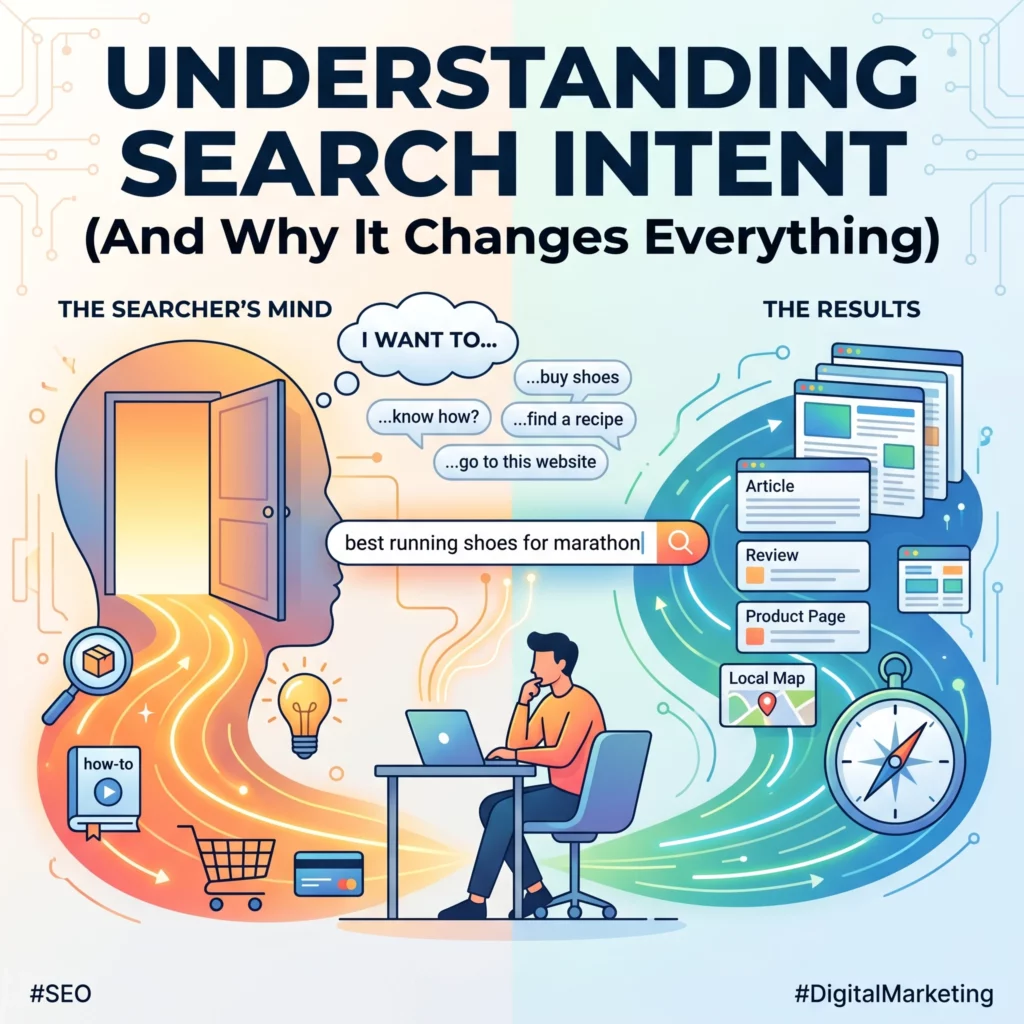
Search intent is the reason someone searches for something online. Some people want information, others want reassurance, comparisons, or solutions. Understanding the difference changes how you write content — and often determines whether people actually click on it.
What Is Search Intent?
Search intent is simply:
the reason behind a search.
When someone types something into Google, Pinterest, YouTube, or even AI search tools, they’re usually trying to achieve something specific.
Sometimes they want:
- information
- reassurance
- a comparison
- a solution to a problem
And those different intentions often need very different kinds of content.
Why This Matters More Than Most Beginners Realise
One of the biggest mistakes people make when building content is assuming:
“If I write something good, people will find it.”
But discoverability depends heavily on matching what people are actually looking for.
A beautifully written article can still struggle if:
- the title is unclear
- the entry point is too vague
- the content doesn’t match the reader’s expectation
This was something I gradually realised while building my travel site case study.
The content itself wasn’t necessarily wrong.
But some of it was difficult to enter.
Different Types of Search Intent
Most online content falls into a few broad categories.
Informational Intent
People want to learn something.
Examples:
- What is affiliate marketing?
- How does keyword research work?
- What is the best time to visit Rome?
These searches are curiosity-driven.
Reassurance Intent
People want to know:
“Am I doing this right?”
Examples:
- How long does it take to make money online?
- Can you start a business with low confidence?
- Is Rome safe for solo travellers?
This kind of content often performs well because it connects emotionally.
Comparison Intent
People are deciding between options.
Examples:
- Wealthy Affiliate vs going it alone
- Wix vs Squarespace
- Audio tours vs guided tours
These readers are usually further along in the decision process.
Action / Solution Intent
People want help solving a specific problem.
Examples:
- How to choose a niche
- How to stop staring at blank pages
- How to use public transport in another country
This is highly practical content.
Why “Good Content” Sometimes Doesn’t Perform
This was one of the biggest mindset shifts for me.
I used to think:
depth automatically creates discoverability
But depth and accessibility are not the same thing.
Sometimes content struggles because:
- the title is too abstract
- the angle is unclear
- readers can’t quickly understand what the article helps with
That doesn’t make the content bad.
It just means the entry point needs to be clearer.
Why Entry Points Matter
I’ve started thinking about content differently now.
Not just:
“Is this good?”
But:
“How does someone enter this?”
That entry point could be:
- a clearer title
- a stronger Pinterest pin
- a short-form video
- a more beginner-friendly angle
The deeper content can still exist underneath.
But people need a doorway first.
This Changed the Way I Build Content
Once I understood search intent more clearly, a lot of decisions became easier.
Instead of trying to write:
“the perfect article”
I started thinking:
- who is this for?
- what are they trying to understand?
- what kind of doorway would help them enter?
That shift changed:
- article titles
- Pinterest strategy
- content structure
- even how I think about video
Why This Matters for AI and Search Engines Too
Modern search systems — including AI-generated search results — are becoming increasingly focused on intent.
Not just:
“Does this article contain keywords?”
But:
“Does this actually answer the kind of question the user is asking?”
That’s why:
- clarity
- structure
- directness
- real experience
matter more than ever.
A Better Way to Think About Content
Instead of trying to “hack” discoverability, it’s often more helpful to ask:
- What problem does this solve?
- What question does this answer?
- What kind of reader is this helping?
When those things become clearer, content usually becomes easier to discover naturally.
FAQ
What is search intent?
Search intent is the reason someone searches for something online. It reflects what they are trying to learn, solve, compare, or understand.
Why does search intent matter?
Matching search intent helps content feel more relevant to readers, which improves discoverability, clicks, and engagement.
Can good content fail because of poor search intent?
Yes. Even strong content can struggle if the title, structure, or angle doesn’t match what readers are actually looking for.
Does search intent matter for AI search results too?
Absolutely. AI systems increasingly prioritise content that clearly answers questions and matches the user’s underlying intent.