
TL;DR
When people start a website, one of the hardest questions isn’t technical — it’s simply: what should I write about?
Experienced site builders rarely rely on inspiration. Instead, they use signals like keyword research, topic structure, and audience intent to decide what content to create next. Once that direction exists, writing becomes much easier and far more sustainable.
The Question Almost Every Beginner Asks
At some point early in building a website, almost everyone runs into the same quiet problem.
They sit down, ready to write… and suddenly realise they don’t actually know what to write about.
Not because they lack ideas entirely. Usually there are plenty of ideas floating around.
The problem is something slightly different.
It’s the feeling that choosing the next article is mostly guesswork.
So people start asking questions like:
- Should I write what interests me today?
- Should I chase trending topics?
- Should I copy what other websites are doing?
And none of those answers feel quite right.
Why It Feels Like Guesswork at First
The early stages of a website can feel directionless because there’s no visible structure yet.
When you’re just starting, everything looks like an equal option:
- every topic
- every question
- every possible article
Without a system, writing decisions tend to bounce between:
• whatever idea pops up first
• whatever feels easiest
• whatever someone else suggested
This is why many new sites start strong but slowly drift into scattered content.
Not because the writer lacks motivation — but because the decision process itself is exhausting.
What Experienced Site Builders Do Differently
Over time, most experienced website builders stop relying on inspiration.
Instead, they look for signals.
Signals answer questions like:
- Are people searching for this topic?
- Is this relevant to my website’s focus?
- Does it connect to other articles I’ve written?
Once those signals exist, the writing process changes dramatically.
Instead of asking “What should I write today?”
The question becomes:
“Which planned topic should I tackle next?”
That shift removes a surprising amount of mental friction.
The Role of Keyword Research
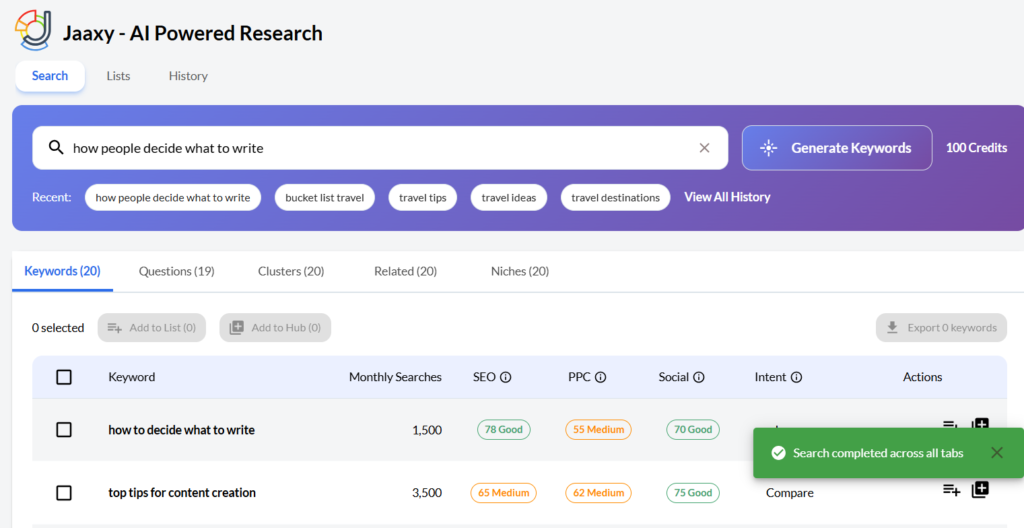
One of the clearest signals comes from keyword research.
Keyword research simply means understanding the questions people are already asking online.
Instead of guessing what readers might want, you can see:
- the phrases people search for
- the problems they are trying to solve
- the language they actually use
Tools like Jaaxy – AI Powered Research make this process easier by showing search demand and topic opportunities.
But the real value isn’t the tool itself.
It’s the clarity it provides.
Suddenly the writing list isn’t random ideas — it’s real questions from real people.
Why Structure Makes Writing Easier
Once you combine keyword signals with topic structure, something interesting happens.
Writing stops feeling like creative pressure and starts feeling more like steady progress.
For example, many site builders organise their ideas around clear topic areas or projects.
Inside Wealthy Affiliate, tools like Business Hubs are designed to support this kind of structure.
Instead of scattered notes or endless idea lists, you can see:
- related keywords
- planned articles
- topic clusters
That structure answers the “what next?” question before you even start writing.
Direction Matters More Than SEO Mastery
One misconception beginners often have is that successful websites require deep technical SEO expertise.
In reality, the most important early skill is much simpler:
Choosing sensible topics consistently.
If you repeatedly write about subjects people care about, within a clear theme, your site naturally becomes easier for search engines — and readers — to understand.
You don’t need to master every ranking factor.
You just need direction.
A Quiet Change in Mindset
Once a website has a working system for choosing topics, something subtle shifts.
Writing becomes calmer.
There’s less pressure to be clever or original with every article.
Instead, you’re simply answering questions, one piece at a time.
And over time, those answers begin to form something much bigger:
A body of work that actually helps people.
FAQ
How do beginners decide what to write about on a website?
Most beginners start by writing about whatever ideas come to mind, but experienced site builders usually rely on signals like keyword research and topic structure. These signals show what people are already searching for and help turn random ideas into a consistent content plan.
Do I need to learn SEO before starting a website?
Not necessarily. While understanding basic SEO helps, the most important early skill is choosing useful topics that people are actually searching for. Once your site has direction and structure, the technical aspects of SEO become much easier to learn.
Is keyword research the only way to decide what to write?
Keyword research is one of the most reliable signals, but it’s not the only one. Many website builders combine keyword research with topic clusters, audience questions, and personal expertise to decide what content to create.
What happens if I just write whatever comes to mind?
Some of those articles may still perform well, but random content often becomes difficult to sustain over time. Without a clear theme or direction, it becomes harder to know what to write next and harder for readers — and search engines — to understand what your website is about.
How do experienced website builders plan future articles?
Most experienced builders maintain a list of topic ideas connected to keywords and larger themes. Tools like keyword research platforms or project planning systems (such as Business Hubs inside Wealthy Affiliate) help organize these ideas so the next article is always clear.